
The national groundwater monitoring network currently has sparse coverage, not all available data are used, and some monitoring points are located in areas or at depths where there is no pollution from agriculture, or where such pollution may not become apparent. The audit also revealed that groundwater samples are mostly taken at times when nitrate levels in the groundwater are lower, and that some of the data required to assess the status of groundwater are missing. Consequently, the Ministry of Climate’s official assessments of the status of groundwater bodies may not necessarily reflect the actual quality of groundwater. The lack of reliable data also makes it difficult to make the decisions necessary to protect groundwater.
Human health and the status of ecosystems depend on the purity of groundwater, but nitrate levels in groundwater are on the rise in several regions of Estonia. Significant nitrate levels have been detected in new drinking water wells built by local residents, and national groundwater monitoring also indicates an increase in the nitrate content of groundwater.
The current fertilisation requirements do not sufficiently minimise the risk of nutrients leaching into groundwater and surface water, partly because the requirements allow fertilisation according to the planned yield, and if the actual yield is lower, the plants do not use up the fertiliser and the surplus may leach into groundwater. The existing time restrictions in the rules on manure spreading should also be reviewed to ensure that the periods when the risk of leaching is particularly high are taken into account better.
The Ministry of Regional Affairs and Agriculture has paid out €366 million in agricultural subsidies during the period 2018–2024, which are expected to have an impact on water protection, but has not assessed the extent to which these various subsidies have had an impact on groundwater protection. Furthermore, the Ministry still has no reliable field-based overview – as highlighted by the National Audit Office in the audit carried out as long as eight years ago – of how much, where and what types of fertilisers, plant protection products and manure are applied. The Ministry of Regional Affairs and Agriculture does not systematically carry out land improvement monitoring to determine the levels of pollutants leaching from fields. Therefore, there is a risk that when planning the funds of the new EU funding period for 2028–2034, the Ministry of Regional Affairs and Agriculture will not have a clear enough idea of which support measures will actually contribute to the protection of groundwater and to what extent.
According to the requirements of the European Union, all 31 groundwater bodies in Estonia must be in a good status by 2027 at the latest, but Estonia will not achieve this target. The Ministry of Climate submits a report on the status of groundwater to the European Commission every six years.An up-to-date overview of the chemical and quantitative status of groundwater bodies is expected to be completed in late 2026.
If Estonia is unable to improve the status of its groundwater or to demonstrate its actual status reliably, this could, in the worst-case scenario, result in infringement proceedings being brought against the Estonian state by the European Union and the imposition of a fine.
The National Audit Office advised the Minister of Infrastructure redesign the groundwater monitoring network, assess the impact of water protection measures on groundwater, and amend the regulations on fertiliser use so as to reduce the risk of nutrients leaching into groundwater.
The National Audit Office advised the Minister of Regional Affairs and Agriculture to ensure that the impact of agricultural subsidies on the status of groundwater is assessed, and to develop land improvement monitoring system which would, among other things, make it possible to assess the impact of agricultural subsidies.
The Minister of Regional Affairs and Agriculture agreed with the National Audit Office’s recommendation to develop a land improvement monitoring system, but there were no clear explanations as to whether and how the assessment of the impact of agricultural subsidies on groundwater would actually be carried out.
The National Audit Office considers it important that the Ministry of Climate speed up the resolution of the many problems highlighted in the audit and not leave dealing with them until the time when the water management plans of the European Union’s next budgetary period, years from now, will be prepared, as groundwater quality affects people’s health and ensuring the purity of groundwater cannot be postponed to an indefinite future.
Background
- There are 31 groundwater bodies in Estonia, which must achieve good status by 2027 according to European Union requirements.
- Agriculture is the main source of nitrate pollution in groundwater, and the measures taken so far have not succeeded in halting the increase in pollution.
- In Estonia, most people get their drinking water from groundwater. If groundwater becomes polluted, it takes a long time to recover, and in some cases this can take decades.
- At present, shallow wells (shaft and drill wells up to 15 metres deep) are under significant pollution pressure, and to avoid problems, it is recommended, among other things, to use groundwater from deeper aquifers for drinking water. In many places, spring water cannot be used as drinking water either.
Nitrate concentrations in springs in nitrate vulnerable zone, 1981–2025
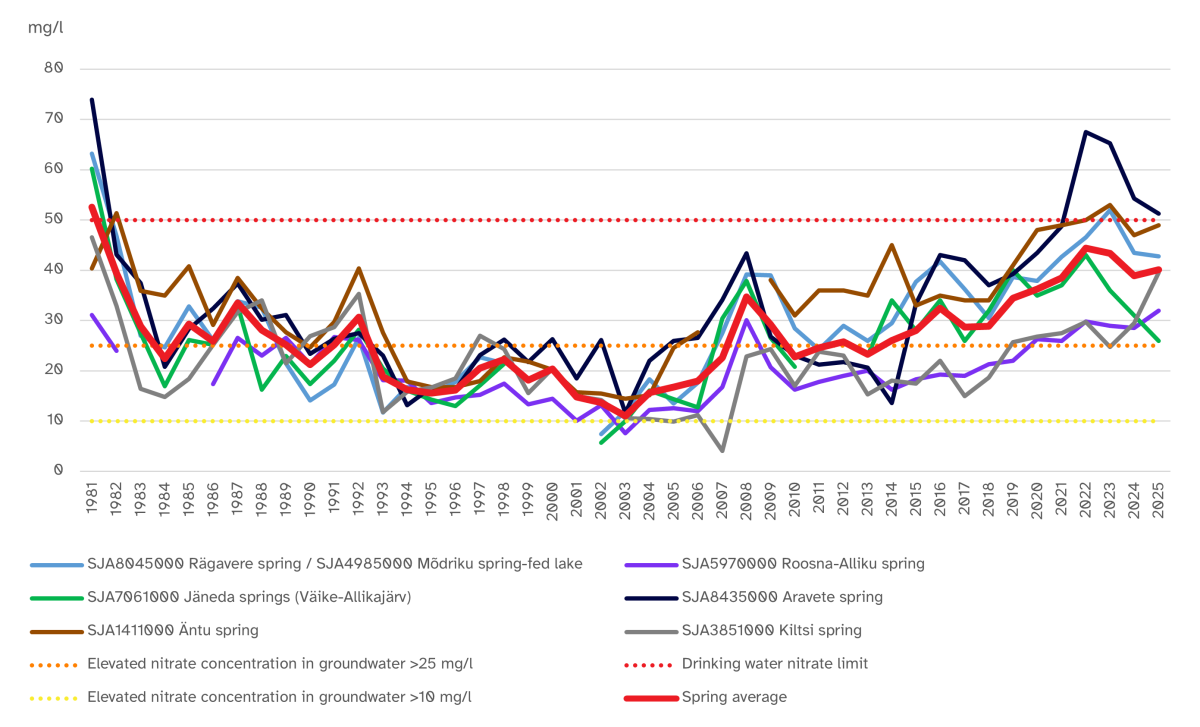
Source: Tallinn University, commissioned by the National Audit Office
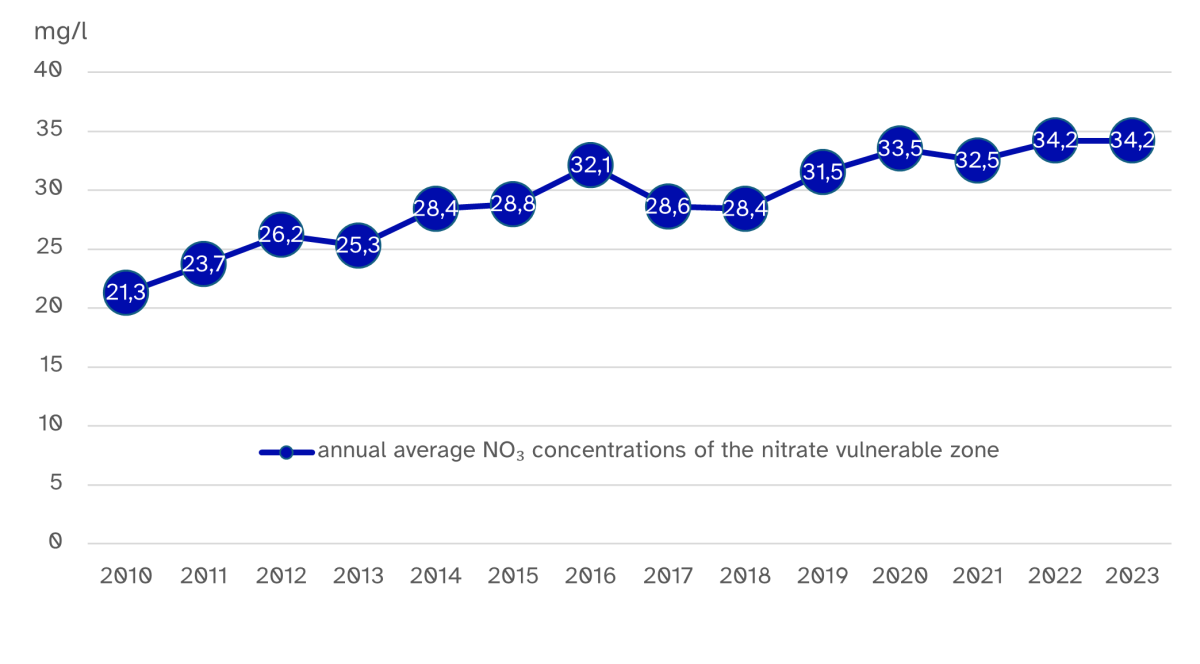
Groundwater monitoring data for the nitrate vulnerable zone show an upward trend in nitrate concentration. Whilst the average nitrate concentration was 30.2 mg/l in the period 2016–2019, it has risen to 33.6 mg/l in the period 2020–2023. In the longer term, the nitrate concentration in groundwater in the nitrate vulnerable zone has increased by approximately 60% since 2010 (see figure).
Trend in nitrate concentration in the groundwater of the Pandivere and Adavere–Põltsamaa nitrate vulnerable area, 2010–2023
Source: National Audit Office, based on data from the Ministry of Climate