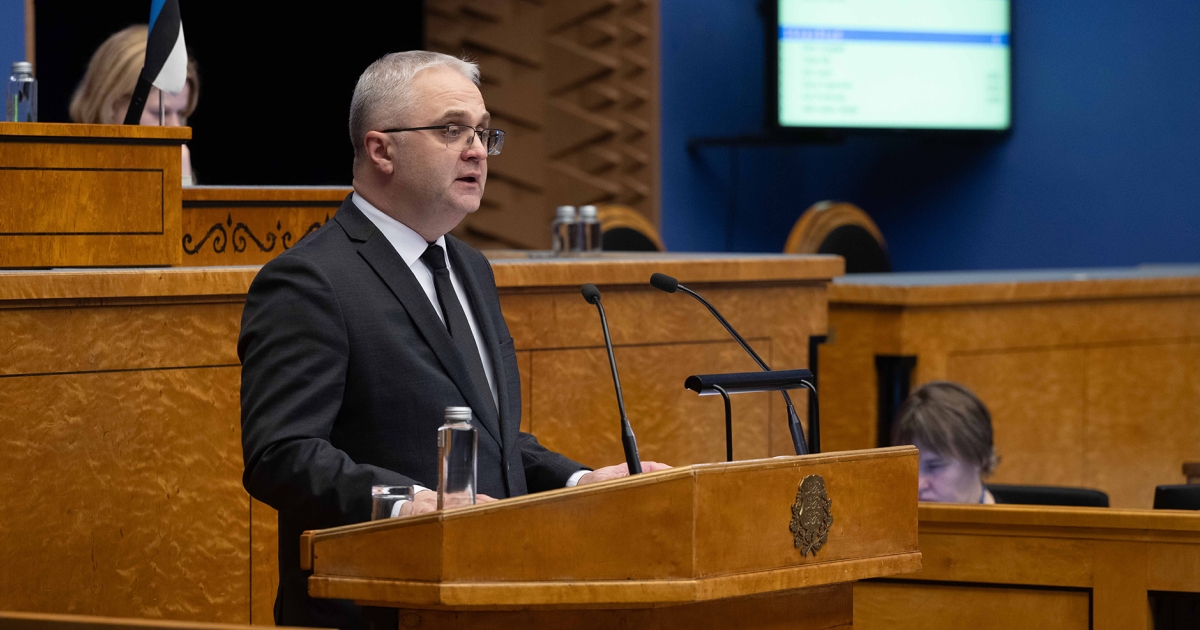
At the beginning of the report, the Auditor General confirmed that the state’s financial statements accurately reflect the state’s financial position, financial performance and cash flows, with one exception: the area of administration of the Ministry of Defence. Defence stocks are incorrectly recognised in the state’s consolidated annual report, because the stock accounting of the Defence Forces is still incomplete. According to the Auditor General, the public must have the assurance and confidence that the money allocated to national defence is being used wisely.
“Trivialising the problem by suggesting that the National Audit Office expects individual cartridges and pairs of boots to be counted is misleading,” said Janar Holm. “We have not even looked into cartridges and boots yet. We are talking about armaments and weapon systems, weapon system components, camouflage gear, and fire control and communications equipment.”
“The slogan ‘More defence capability for every euro’ rings hollow if it takes years to gain clarity on how millions of euros are being spent,” said the Auditor General, referring to recurring problems that have come to light in various annual reports.
In his report, Holm pointed out that last year, the Estonian Centre for Defence Investments continued to face serious problems with the management of the contracts. There were instances where the terms of the contract were not complied with, or where the contract had not been signed. Due to errors in the documents, it was not possible to ascertain under which contract the goods were received, when they were received, or whether they were delivered at all. Nor was it always checked whether the goods purchased and received complied with what had been agreed.
“We checked just 64 contracts, and even in that sample we saw a systemic problem,” said Holm. “In such a mess, the state may make incorrect payments, some of the equipment may not be received, and breaches by suppliers may go unnoticed. The state may lose money, and the Defence Forces may be left without the equipment they had counted on having.”
Continuing on the subject of the state’s fiscal policy, Janar Holm pointed out that ministries are essentially abandoning the self-evident principle that a budget approved by a minister is a document which should determine what the money may be used for and how much may be spent within the ministry’s area of administration. In fact, in two-thirds of the ministries, the minister did not approve the final allocation of budget expenditure for their respective areas of administration for 2025 until several months after the end of the financial year, by which time the expenditure had already been incurred.
“The approval of the budget has turned into cost-washing,” Holm remarked. “If we want officials and agencies to take the budget seriously, ministers must be the first to take it seriously. Otherwise, the message is quite clear: spend as you see fit and we will sort out the paperwork later.”
Another significant problem highlighted by Janar Holm is that in a situation where the projected budget deficit amounts to 4 per cent of the gross domestic product, the state does not have a clear overview of how much of the budgetary funds for future years has already been committed to contracts and other obligations. The Ministry of Finance does not monitor whether ministries adhere to the limit on the assumption of long-term liabilities.
“Approximately half of the ministries said they were keeping track, but not a single one was able to provide us with the relevant records,” said Holm. “The rest admitted honestly that they do not monitor it.”
Furthermore, there is no comprehensive view of the state’s use of funds, as demonstrated by the audit of the venture capital funds of SmartCap, which was completed this summer. Late last year, these funds held over a quarter of a billion euros in available funds allocated by the state for future investments and expenditure, a large proportion of which was in SmartCap’s fixed-term deposits. At the same time, the state borrowed money to cover its day-to-day expenses, and SmartCap was even paid a management fee for the funds still waiting to be invested. “We put money on hold with one hand and with the other, we borrow more,” said Holm. “This is not inevitable, but a question of how the management of funds is organised.”
In his presentation, Janar Holm also addressed the recently published annual report, which focuses once again on trends in the Estonian healthcare sector, like it did four years ago. “Back then, the Minister of Health and Labour said that we had reached a point where decisions could no longer be postponed,” Holm recalled. “Last year, I promised right here that, when preparing this year’s report, we will also check whether these urgent decisions have been made.”
The Auditor General considers that there are currently more reforms underway than the healthcare system is capable of implementing. According to him, the objectives set may be the right ones, but all the planned reforms require the same staff, funding and effective data solutions. However, there are not enough of them and everything cannot be done at once.
“Four years ago, development plans were proposed as a solution to a number of problems,” said Janar Holm, pointing out that whilst the plans have been finalised, the problems largely remain. “This September, there were 16 strategy documents in addition to the National Health Plan, with a further seven currently being drafted or planned. We can already offer patients a fairly broad selection of strategy documents. The choice of appointment slots is considerably more limited."
In the opinion of the Auditor General, there is no lack of capacity to prepare development plans, but the capacity to act in accordance with them is not there. The Ministry of Social Affairs should decide which changes can be implemented first using the existing staff, funding and IT solutions, and which previously promised changes will therefore have to be put on hold.
“The preparation of a development plan is becoming a convenient way of showing that work is being done, without having to make difficult choices,” said Holm, pointing to a similar pattern that emerged when an action plan which promised to give special attention to South-East Estonia was audited. “Attention shifts from the unresolved issue to the document being prepared. Answering the question of what will be done with the existing options and what will be abandoned can be thus postponed. As it stands, the development plan no longer helps to make decisions but instead provides a reason to postpone it. The planning of development has turned into stalling development.”
Janar Holm talked about how grand ambitions in the areas of civil protection and crisis preparedness fizzle out. “Getting going with much noise and momentum and then quietly lowering the bar wastes working time and money, and the necessary preparedness is not achieved,” continued Holm and added that the Government should decide what level of preparedness we must ensure and by when and secure the necessary funding and people to achieve this. “It must be stated clearly when the goal is lowered, as otherwise it creates a misleading impression of the state’s preparedness. We should not turn the establishment of a goal into a major public event whilst letting its abandonment quietly fade away without saying what we are not prepared for and what risk we take by doing this,” summarised Holm.