

Executive Summary
The estimated costs of implementing the Rail Baltica project has increased more than 4 times. According to new cost benefit analysis draft, since 2017, the estimated preliminary cost of developing the Rail Baltica project has increased from €5.8 bn to €23.8 bn in 2023 (see Figure 1).
Figure 1. Cost increase, in billions of euros
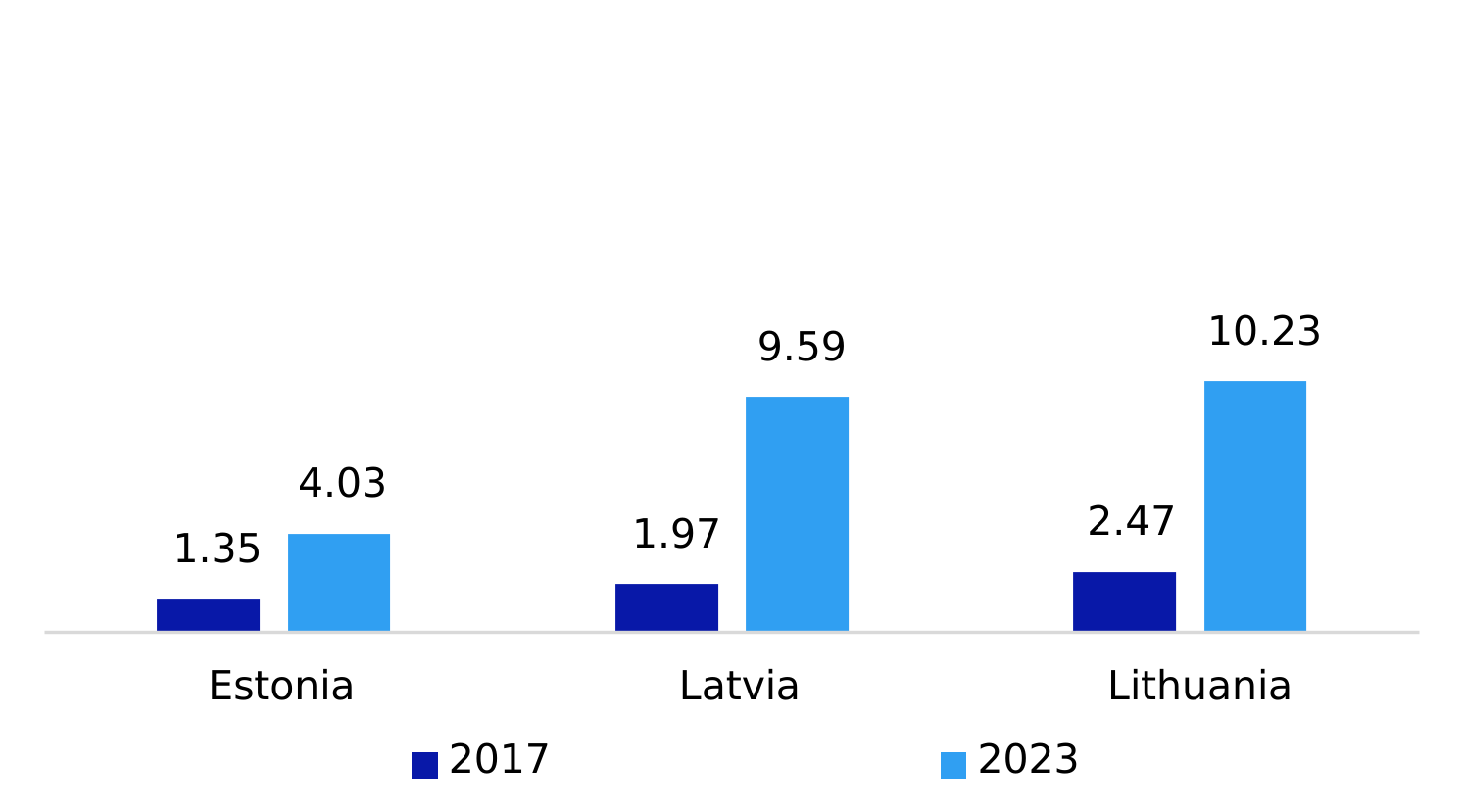
Source: SAIs based on 2017 CBA and new CBA draft
This has increased the risk of securing on-time financing and not only because the estimated costs have increased, but also because the current European Union funding period ends in 2027. As the next funding period will begin in 2028, there will probably be a gap in financing for years 2027-2028. In addition, there is no certainty that the Connecting Europe Facility – which is the main financing tool for the project – will be continued in the upcoming financing period or that its budget or co-financing rate is known at this point. That being said, taking into account the new project budgets in each country and the already allocated funds, there are additional funds in the amounts of €2.7 bn in Estonia, €7.6 bn in Latvia and €8.7 bn in Lithuania needed to complete the project.
To reach the project deadline set in the European Union Regulation - 2030 - and manage increased costs Estonia, Latvia and Lithuania have decided to implement the Rail Baltica project in two phases. The delivery of the first phase of the project is expected to be completed in 2030 which is at least five years later than the initial project’s schedule which set the deadline for finishing the construction of the railway at the end of 2025. In the first phase the Rail Baltica project will be built in a reduced scope, e.g., local stops are to be built later or in minimal functionality, only one set of tracks will be built instead of two in some sections of the railway, etc. This also helps to reduce estimated costs from €4 bn to €3.1 bn in Estonia, from €9.6 to 6.4 bn in Latvia and from €10.2 to 5.4 bn in Lithuania until the year 2030. This means that in the case of implementing the first phase of the project, the additional funding need for the whole project is 10.1 billion euro, being 1.8 billion in Estonia, 4.4 in Latvia and 3.9 in Lithuania.The second phase of the project implementation will take place after trains have started to operate on the railway which is planned to take place in 2031. Currently there is no schedule for the second phase.
Risk management on the entire project level needs further development. The 2019 cooperative audit identified that, although risks had been identified, assessed, and prioritized, a risk management system that would tie the whole project into one, was still under development. Also, the 2019 audit identified that there were no mechanisms for change management on the entire project level. The aforementioned shortcomings still exist, though RB Rail AS has recently developed new risk and change management procedure to improve the situation. This review shows that risk management and change management of RB Rail AS and national implementers in regards to the entire project has not notably improved since 2019 even though an effective risk and change management system could help to keep cost increases under control and to take corrective measures quickly if needed. It was also discovered that the governments and the parliaments were not always informed about the problems that might occur.
The only decision taken by the three Baltic States about infrastructure management is that there will be a separate independent manager in each country. Yet, there is still only interim infrastructure manager in Latvia. Although the implementers – RB Rail AS and national implementers – have developed a plan of action to reach operational readiness by 2030, there is no mechanism to force the responsible ministries to make the decisions more quickly. It was determined that the ministries had not decided on the model for acquiring the trains nor on the entity that was designated responsible for the task. If the decision is not taken soon, there is a risk that there will be no trains to operate on the railway in 2030/2031. Furthermore, the cost of acquiring the trains as well as maintaining and operating the railway are not included in the project budget, and cannot be financed from European Union funds.