
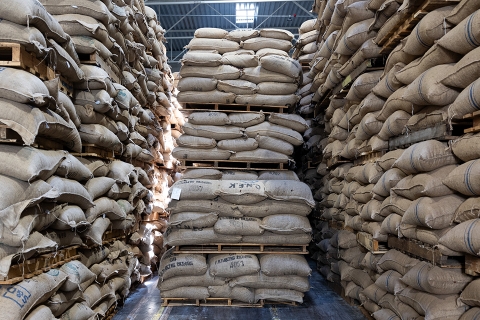
The Estonian Stockpiling Agency (AS Eesti Varude Keskus, EVK) has created food stocks that are estimated to be sufficient for 10% of the population for 30 days. However, the size of the stock is not linked to possible needs during a specific emergency or national defence crisis, and it does not correspond to the target set by the Government of the Republic, which is to guarantee food stocks for the entire population for 14 days. Therefore, it cannot be said that the stocks are sufficient and will reach everyone in need during a crisis in case of a shortage of food.
Healthcare stocks have been created in the required nomenclature and quantities, except for the stocks of pharmaceuticals, of which just over 90% is available.
It is possible to be certain that a stock can be smoothly taken into use only in the case of a stock of pharmaceuticals where the process of taking the stock into use is clear to all parties and they have been actually taken into use on three occasions already. The process of taking the food stocks, veterinary medicinal product stocks, personal protective equipment stocks, and bought‑out part of medical devices and supplies into use has not been comprehensively agreed or practised, so taking them into use may not be equally successful.
Main observations of the National Audit Office
The target set by the Government of the Republic for the creation of food stocks (for the entire population for 14 days) has not been met. The EVK itself has set a more achievable target level. Based on the conditions set out in the Emergency Act, the EVK has established universal stocks that can be mobilised in the event of various crises, including emergencies, evacuation and national defence crises. The food stocks can be used to feed people as well as to make food parcels.
In setting the target level for food stocks, the Estonian Stockpiling Agency has mainly relied on market possibilities and not on the expectation set by the Government of the Republic or on possible needs caused by crisis situations. However, the target set by the Government of the Republic has not been changed. The supervisory board of the Estonian Stockpiling Agency (EVK), chaired by a representative of the owner, i.e. the Ministry of Economic Affairs and Communications, acknowledged the need to set a more manageable target for the establishment of food stocks at the end of 2022. The Ministry of Regional Affairs and Agriculture, which is responsible for the security of food supply, has also accepted the target level set by the EVK.
The Estonian Stockpiling Agency (EVK) has established food stocks that are sufficient to feed 10% of the Estonian population for 30 days. Approximately two-thirds of the food stocks created by the EVK are flour. However, the contract partner provides half of this quantity as grains, i.e. essentially as raw material. According to the agency, the size of the Estonian food market does not allow it to significantly increase the volume of delegated food stocks. Although the EVK has largely proceeded from the composition of food stocks and the respective quantities recommended by the Ministry of Regional Affairs and Agriculture, it has still decided independently what and in which quantities are included in the food stocks. The supervisory board of the agency has accepted the activities of the agency.
It was impossible to assess in the audit whether the volume and composition of the food stocks are sufficient to ensure that the people in need are supplied with food. As with the target for food stocks mentioned above, the volume and composition of the food stocks achieved to date does not correspond to the needs that the solution of a specific crisis situation may create.
A little over 90% of stocks of pharmaceuticals has been created. The Ministry of Social Affairs has not decided what to do about the rest. Although the possible solutions for the active ingredients that have not yet been stocked are known to the agency, the Ministry of Economic Affairs and Communications and the Ministry of Social Affairs, there are no specific decisions to address the situation. The State Agency of Medicines already sees the need to amend the list on which the stocks of pharmaceuticals are based and to increase, among other things, the quantities of active ingredients in the stocks that the EVK has so far been unable to obtain. In the opinion of the National Audit Office, it is therefore important to urgently decide how to ensure stocks of all the necessary pharmaceuticals, or what to do with the part that could not be procured to date.
The process of taking the stocks of pharmaceuticals into use is clear to all parties and the stocks have been actually taken into use on three occasions already. The activities necessary to take stocks of food, veterinary medicinal products, personal protective equipment and bought‑out medical devices and supplies into use have not been comprehensively agreed or practised. The EVK is responsible for ensuring that the company maintaining the delegated or bought‑out stocks receives the necessary information and submits a release order to the company in the event the stocks are taken into use. The EVK is not responsible for the further distribution of the stocks. Activities have not been agreed comprehensively, i.e. from the decision to take the stocks into use until they reach the people in need, and there are the following problems:
- The Ministry of Regional Affairs and Agriculture and the Estonian Stockpiling Agency have thought through and recorded the process of taking food stocks into use, from the preparation of the decision of the Government of the Republic to the transport of the prepared food stocks to the location specified in the decision. However, it has not been thought through or agreed how the food stocks will reach local authorities and the specific people in need.
The Estonian Stockpiling Agency has organised exercises on taking the food stocks into use, but no exercise for all parties involved in this process, including local authorities, has been organised. In the opinion of the National Audit Office, it is important to agree on how local authorities should organise the distribution of food stocks and how the food stocks will reach the specific people in need. This requires the preparation of a comprehensive plan, which would outline the roles, responsibilities and activities of all parties. The functioning of the system as a whole must also be tested in exercises. - Taking the stocks of veterinary medicinal products into use had not been practised at the time of the audit.
- The principles of possible distribution of personal protective equipment if taken into use have not been agreed. According to the guidelines in force at the time of the audit, hospitals, EMS providers, the centres of family physician care and social welfare institutions generally have to go to the warehouse of the company maintaining the delegated or bought-out stocks to collect the stocks themselves. The Ministry of Social Affairs assumes that all institutions are ready for this and has not informed them separately.
- There are many institutions that potentially need stocks, which is why the National Audit Office finds that the Ministry of Social Affairs cannot simply expect everyone to be ready to act when the stocks are taken into use without officially informing the institutions and practising the activities in advance. The personal protective equipment may not reach all persons in need – especially in social welfare institutions – unless clear principles for distributing them are prepared.
- In the case of the stocks of medical devices and supplies, the organisation of taking the delegated stocks into use and the roles of the parties involved have been agreed and taking the stocks into use has also been practised once during an exercise. However, taking the bought-out stocks (which account for about a fifth of the items in stock) into use is a concern, as neither the EVK nor the Ministry of Social Affairs knows how the necessary products are supposed to reach those in need. The EVK has neither the right nor the capacity to distribute medical devices and supplies to people itself.
The Estonian Stockpiling Agency sees the creation of all stocks as delegated stocks in the future as the solution to the problem. However, in the opinion of the National Audit Office, the question of how to take into use the products that have already been bought out cannot be overlooked – they have been stocked because they are important to people, so it must be clear how they would reach the people in need if necessary.
Recommendations of the National Audit Office
Recommendation of the National Audit Office to the Minister of Economy and Industry in cooperation with the Minister of Regional Affairs and Agriculture: set a clear, measurable and achievable objective for the establishment of food stocks, which is also in line with other measures of security of food supply and the scenarios of the national defence action plan, and present the agreed clear task to the EVK to fulfil.
Recommendations of the National Audit Office to the Minister of Regional Affairs and Agriculture, the Minister of Economy and Industry and the Chairman of the Management Board of the EVK:
- draft a plan for taking the food stocks into use, based on the scenarios in the national defence action plan, including agree on the roles and tasks of the parties involved in taking the food stocks into use in the organisation of taking the food stocks into use;
- initiate the regulation of the task of local authorities to distribute food stocks and provide them with the necessary resources to carry out this task;
- practise taking food stocks into use, including the delivery of food stocks (communication, logistics) to local authorities and their distribution to those in need.
Recommendation of the National Audit Office to the Chairman of the Management Board of the Estonian Stockpiling Agency and the Minister of Regional Affairs and Agriculture: agree on the actions required in the event of taking the stocks of veterinary medicinal products into use and carry out a comprehensive exercise on taking the stocks into use.
Recommendation of the National Audit Office to the Minister of Social Affairs: decide how to handle the pharmaceuticals in the list of the strategic operation stockpile that have not yet been procured; in other words, how to ensure that there are stocks of all the necessary pharmaceuticals.
Recommendations of the National Audit Office to the Chairman of the Management Board of the Estonian Stockpiling Agency and the Minister of Social Affairs:
- comprehensively practice taking the stocks of personal protective equipment into use, including the preparation of a distribution plan;
- ensure that the bought-out medical devices and supplies can be taken into use.
- the Ministry of Economic Affairs and Communications is prepared to update the objective of the food stocks in the strategic operation stockpile of the state in cooperation with the Ministry of Regional Affairs and Agriculture.
- The process of taking the state’s food stocks into use has been agreed up to the local authorities between the Ministry of Economic Affairs and Communications, the Ministry of Regional Affairs and Agriculture and the Estonian Stockpiling Agency, and it has been presented to the representatives of the Ministry of Social Affairs, the Ministry of the Interior and the Rescue Board.
- Receiving food stocks in a local authority and distributing them to those in need is the provision of emergency social assistance, which is the responsibility of the Ministry of Social Affairs. The organisation of the provision of social assistance is a duty of local authorities under current law and does not require separate regulation.
- There are plans to practice taking the food stocks of the strategic operation stockpile into use during the nationwide crisis exercise Ilves in 2026.
- the Ministry of Regional Affairs and Agriculture does not agree that the objective of the food stocks set by the Government of the Republic was changed with the consent of the Ministry. The EVK has informed the Ministry that the Estonian market does not allow for the creation of larger food stocks than the current volume of contracts without significant additional funding, but the Ministry was not involved in the underlying analysis. The Ministry of Regional Affairs and Agriculture, in cooperation with the Ministry of Economic Affairs and Communications, is ready to set a new objective for the prepared food stocks in the strategic operation stockpile. However, it may not be possible to achieve the updated and relevant objective without additional funding.
- In December 2025, the Ministry of Regional Affairs and Agriculture presented the process of taking food stocks into use in the regional crisis committees. The only thing the Ministry has not negotiated with local authorities is the distribution of food stocks to the people in need. This falls into the area of emergency social assistance and has been presented at crisis seminars by the Ministry of Social Affairs. The Ministry of Social Affairs organises instructing local authorities on how to provide emergency social assistance in a crisis through the Social Insurance Board, which will ensure that the respective guidance is in place by the end of 2027 at the latest.
- The Ministry of Regional Affairs and Agriculture agrees that the process of taking stocks into use needs to be practised as a whole. This should also include the distribution of stocks, but this remains part of providing emergency social assistance. Emergency social assistance as a national defence task and the related policy-making is a responsibility of the Ministry of Social Affairs.
- The Ministry agrees with the proposal to carry out a comprehensive exercise on taking the stocks of veterinary products into use. The exercise has been agreed with the Ministry and the EVK and will take place in the first half of 2026.
The Estonian Stockpiling Agency has informed the Ministry of Regional Affairs and Agriculture that it is not possible to build up the food stocks to the target level set by the Government of the Republic. The Ministry has not raised any objections to this. In the opinion of the National Audit Office, this shows that the Ministry of Regional Affairs and Agriculture has not actively worked to direct the activities of the EVK in the establishment of food stocks at the target level set by the Government of the Republic.
- The EVK agrees with the recommendation of the National Audit Office to draft a plan for taking the food stocks into use as a whole. The EVK also agrees that there is a need for greater clarity of roles and responsibilities, with an emphasis on the management of taking the food stocks into use at the end of the logistics chain, i.e. from interim storage to the final consumer.
- The exercise on taking veterinary medicinal products into use planned for autumn 2025 was postponed at the suggestion of the other parties due to the outbreak of African swine fever and is scheduled to take place in March 2026.
- The EVK agrees with the recommendation to practice taking the stocks of personal protective equipment into use and proposes that the parties start planning a joint exercise in this regard.
- Consultations with the Ministry of Social Affairs on taking medical devices and supplies into use will be launched and the objective is to come up with a solution in 2026.
- The pharmaceuticals that were not stockpiled are affected by long-term supply difficulties. Pharmaceuticals without marketing authorisation cannot be included in the strategic operation stockpile, as they may be left in the warehouses of wholesalers and expire. Until now, we have been waiting for the end of the supply difficulties, so that stocks can be created. The Ministry of Social Affairs proposes to the EVK to set up an advisory board of health professionals to develop a common position on stockpiling pharmaceuticals that have not been stockpiled yet due to supply difficulties.
- An exercise in taking personal protective equipment into use is expected to take place in 2027.
The pharmaceuticals missing from the stocks have not been procured during the entire time when stocks of pharmaceuticals have existed. The proposal of the State Agency of Medicines made in 2025 to amend the list on which the stocks are based shows that some of the pharmaceuticals missing from the stocks have become even more important, as the State Agency of Medicines considers it necessary to increase their quantity. According to the National Audit Office, simply waiting until supply difficulties have ended is not enough to ensure stocks of all the necessary pharmaceuticals.
The National Audit Office does not agree with the view of the ministries that by receiving and distributing food stocks, local authorities are fulfilling their duty to provide emergency social assistance. According to § 16 of the Emergency Act, local authorities must assist in the evacuation of persons and provide accommodation and food to the evacuees. However, this task cannot be equated with the obligation to provide emergency social assistance imposed on local authorities by the Social Welfare Act. Although a national defence task with a similar name has been established for the Ministry of Social Affairs in the national defence action plan, it cannot be extended to local authorities.