

Summary of the report
Achievement of greenhouse gas reduction and nature restoration targets in the land use and forestry sector
11/13/2026 | 168 kB | pdf
Press release
The achievement of Estonia’s ambitious climate targets in the LULUCF sector is questionable
11/18/2026
LULUCF
Land Use, Land-Use Change and Forestry.
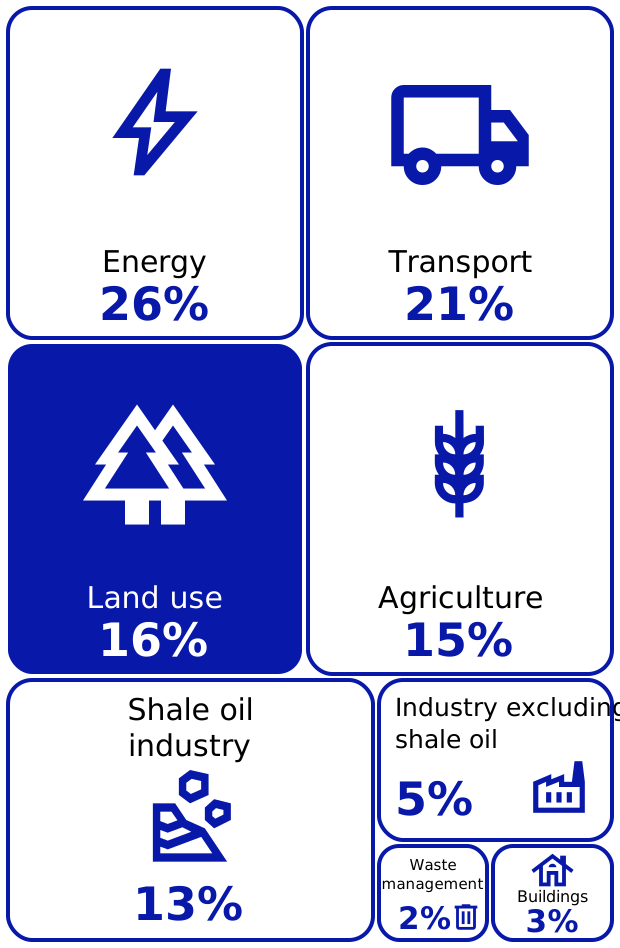
Approximate share of greenhouse gas emissions from various sectors in Estonia in 2024
Source: Ministry of Climate
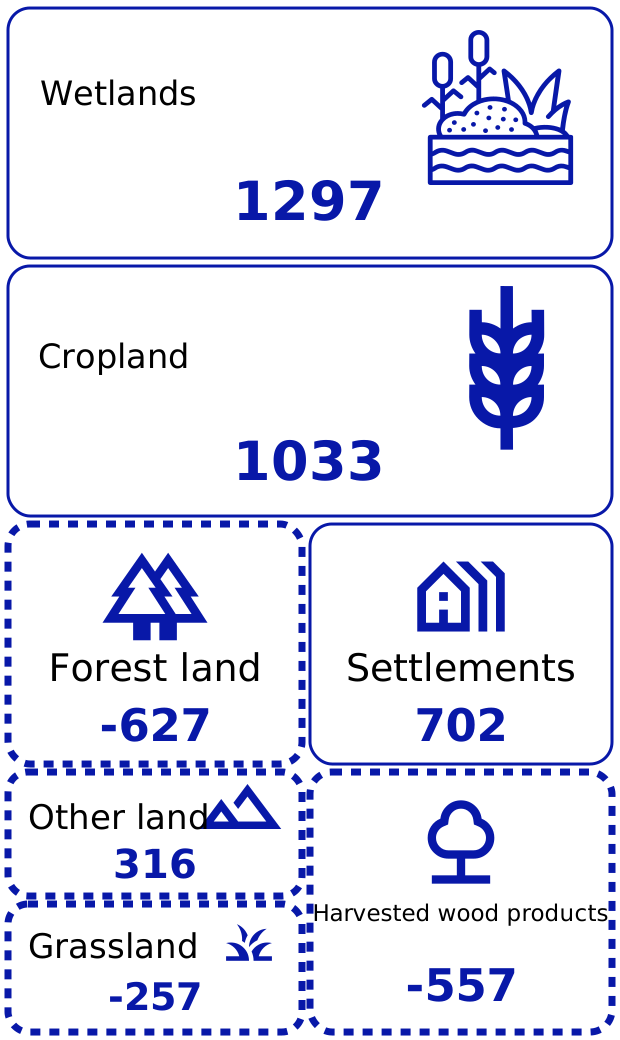
Greenhouse gas emissions and removals from the LULUCF sector in 2024, thousands tonnes of CO2 equivalent
Source: Environment Agency
The target set by the European Climate Law is to reduce greenhouse gas emissions in the European Union and to achieve climate neutrality, i.e. a situation where the amount of greenhouse gases released into the atmosphere is equal to the amount that is sequestered or removed, by 2050.
The largest share of greenhouse gas emissions comes from the energy sector. The LULUCF sector accounted for 16% of Estonia’s total greenhouse gas emissions in 2024 and is the only sector where it is possible to remove large amounts of carbon as a result of natural processes. This is the reason why LULUCF has been assigned a very important role in achieving the European Union’s climate policy objectives.
The EU LULUCF Regulation is the main piece of legislation governing the LULUCF sector, setting binding targets for Member States to reduce emissions from this sector.
The National Audit Office has carried out a review of the obligations arising for Estonia from the LULUCF Regulation, the status of their achievement, and the measures that Estonia has implemented to fulfil these obligations.
- During the first accounting period of the LULUCF Regulation (2021–2025), the accounted emissions and removals from the LULUCF sector had to be balanced. Removals could exceed emissions, but emissions could not exceed removals. According to the current data, the obligation for the first accounting period has not been fulfilled. Estonia’s estimated deficit is approximately 10 million tonnes of CO2 equivalent. However, whether the obligation has or has not been fulfilled will become clear in 2027, when the impact of the change in the calculation methodology becomes apparent and negotiations with the European Commission on the calculation of the reference level for forest land are finalised. If this obligation is not fulfilled, it may give rise to the situation where Estonia will have to purchase so-called land removal units from other countries, the availability and price of which are not yet known.
- In the second accounting period of the LULUCF Regulation (2026–2030), Estonia’s country-specific target for the LULUCF sector for 2030 is to achieve 0.434 million tonnes of CO2 equivalent in additional carbon removal or emission reductions compared with the average emissions during the reference years (2016–2018). The assessment of progress towards the 2030 target has changed significantly due to changes in accounting methodology. Whilst earlier calculations indicated that in order to meet the target, projected emissions would have to be reduced by approximately 1.8 million tonnes, the 2026 calculations show that the difference is approximately 0.1 million tonnes. The change is primarily due to updates to the emissions calculation methodology. In addition, Member States will be allocated a budget for net greenhouse gas emissions and removals for 2026–2029, derived from each Member State’s trajectory towards the achievement of its binding LULUCF target for 2030. A final assessment of the fulfilment of the obligations for the second accounting period will be made in 2032.
- According to the Environment Agency’s projection, emissions from the LULUCF sector will amount to approximately 1.6 million tonnes of CO₂ equivalent in 2050, even with the proposed additional measures. As the LULUCF sector is expected to remain a source of greenhouse gas emissions also in 2050 according to current projections, Estonia as a whole will not achieve climate neutrality by 2050. Existing and additional measures to reduce greenhouse gas emissions from the LULUCF sector are described in the report on measures and projections as well as in the National Energy and Climate Plan. Their content is generic and there is no information on their impact. In some instances, the descriptions of the measures are limited to summarising the general objectives of legislation and development plans. The socio-economic impact of the measures has also been inadequately assessed.
The European Union has also established the Nature Restoration Regulation,and the achievement of its objectives has an impact on LULUCF and greenhouse gas emissions. From the perspective of emissions targets for the LULUCF sector, activities that reduce greenhouse gas emissions and increase carbon removal are particularly important in the context of the Nature Restoration Regulation. In order to fulfil the objectives of the Regulation, the Ministry of Climate, in cooperation with the Ministry of Regional Affairs and Agriculture, should have submitted a draft restoration plan to the European Commission by 1 September 2026. Estonia did not submit the required action plan by the deadline, and the deadline for submitting a new action plan is 31 December 2026.
The Minister of Energy and the Environment, the Minister of Regional Affairs and Agriculture, and the Director General of the Environment Agency submitted their comments on the draft, on the basis of which the National Audit Office has updated the text. See more on pp 25–35.
The Minister of Energy and the Environment and the Director General of the Environment Agency pointed out that changing the methodology for calculating greenhouse gas emissions has no impact on reducing emissions, as the introduction of the new methodology also involved revising data from previous years.
Summary of the report
Achievement of greenhouse gas reduction and nature restoration targets in the land use and forestry sector
11/13/2026 | 168 kB | pdf
Press release
The achievement of Estonia’s ambitious climate targets in the LULUCF sector is questionable
11/18/2026
LULUCF
Land Use, Land-Use Change and Forestry.
Approximate share of greenhouse gas emissions from various sectors in Estonia in 2024
Source: Ministry of Climate
Greenhouse gas emissions and removals from the LULUCF sector in 2024, thousands tonnes of CO2 equivalent
Source: Environment Agency
The National Audit Office used the officially submitted national inventory documents, in which the Environment Agency had carried out the necessary recalculations across the entire data set. This is the reason why the average value for the years 2016–2018 has also changed in the latest national inventory documents. The National Audit Office compared data from the inventories prepared using different methodologies in order to demonstrate the impact of the changes in the accounting methodology.