From 2019–2024, €600 million to €2.2 billion of state budget funds per year remained unused with their use mostly postponed. More than half of the funds unused last year were foreign support, mostly from the European Union, and revenue from sales of CO2 quota. However, approximately €600 million collected from national taxes and meant for use also remained unused in 2024. These funds were almost entirely carried forward to 2025.
“Budgeting is becoming increasingly more like a game of hide and seek,” said Auditor General Janar Holm. “Ministries mask their budgets due to the cuts by the government whilst cuts made with a ruler seem to be the only option for the government to manage the budget and the deficit in such shrouded conditions. At times, it may seem that it’s easier for the Riigikogu and the government to increase state revenues partly through taxes than to constantly force the state apparatus to assess critically and with discipline which costs are really necessary and affordable.”
Public reporting on the state budget and its use does not make it possible to say with reasonable effort why one or another specific expense or investment of the state was not made or was postponed. This can be observed only in general, at the level of the state budget programme activities. The money that remained unused in 2024 was mostly in the sectors of climate, transport, national defence and education. A noticeably large share of money for the transition to Estonian-language education (€43 million), for supporting the research and development activities of companies and developing the digital sector remained unused. According to ministries, the fact that money is not used or is left unused does not have a visible impact on the objectives and results of their areas of government.
Ministries claim that some of the allocated state budget funds remain unused mainly due to the following reasons:
- some of the funds are booked with obligations and pending payout in the next year or the emergence of expenditure in accounting;
- significant (one-off) amounts have been allocated to the areas of government, the use of which during the budget year was unrealistic and this was often already known at the time when the money was allocated;
- many projects and activities take several years and do not fit well into the framework of a annual budget;
- the allocation of money near the end of the year increases the risk that it will remain unused in the same year (e.g. when money is allocated from the government’s reserves);
- procurements fail and deliveries are delayed due to the agencies themselves and other parties;
- in respect of foreign support, the mindset that there is no rush with its use still tends to prevail. There is also the problem that money may remain unused not because of the provider of the support, but the recipient, because there is little interest or the preparation of payment requests and documents is slow.
“An example of how the allocation of money from the state budget and its practical use are not really in sync is the case of the emergency sirens of the Ministry of the Interior. Money for the installation of emergency sirens was allocated from the supplementary budget for 2022, even though it was known that using the money in the year it was allocated was not realistic,” said Auditor General Janar Holm. “The story started with political fanfare, but a working solution is still being worked on.”
As a response to the government’s desire to cut public spending, ministries leave some of the state budget funds unused and carry them over to the following year to keep a financial coping buffer. The impact of such practices on the activities and results of the areas of government is not monitored. The desire of ministries to build up reserves to cope with ongoing austerity measures, to prepare for future spending cuts and to keep a financial buffer for unexpected costs and additional tasks for which no money is allocated from the state budget has emerged as a significant reason why the funds are not used.
Although a lot of money is left over due to multi-annual and lagging projects, there is no clear overview of such commitments. Some of the money that remains unspent in the budget year is already booked, according to ministries, under various commitments and pending payout or the incurrence of accounting expenditure in the following year. The problem is that there is no consistent data to assess how big the share of such funds actually is.
“It’s as if the state has money lacking and left over at the same time, and that’s somewhat true, but at the moment it’s not known where there is too much and where there is a shortage, and this is not taken into account when new state budgets are prepared,” said Auditor General Janar Holm. “In a situation where more is being invested in Estonia’s security, the state’s other expenditures cannot be as inert as before. One option is to critically reassess whether all the so-called ‘booked’ expenditure in the state budget is actually booked or should remain booked. The state’s current budgetary strategy for the next four years foresees government expenditure that is almost €8 billion higher than revenues. There is no reason to think that the pressure will ease after 2030.”
At the same time, the allocation of state budget funds, both between areas of government and agencies within the areas of government, is too inert. A large share of state budget expenditure slides from year to year without ministries and the Ministry of Finance assessing critically enough whether the expenditure is significant and opening up a debate on, for example, whether all fixed or indexed state budget expenditure should remain so. The allocation of money from the state budget within the area of government is largely an automatic process, where the prior use of money and its monitoring generally play no visible role. The budget departments in ministries usually have a fairly good overview of how money is spent, but it does not seem to be of much use in preparing the budget of the area of government. The Ministry of Finance also has a good opportunity to analyse and take into account the balances during the budget review.
Excessive inertia in applying for, using and transferring state budget funds has been fostered by the deliberate decision of the Ministry of Finance from years ago to reduce its role as the substantive controller of the state budget. The idea was to give ministries more responsibility and flexibility in planning and using their budgets, but this has rather taken the budgeting process to the beaten track and reduced critical assessment of the need for spending. This altogether has deepened ‘defensive budgeting’, which works against the goal of the government and the Ministry of Finance to put in practice the activity-based budgeting formally in force in Estonia: to use public money effectively, in a managed way and without ‘silos’ between state agencies.
The National Audit Office recommends that ministers introduce or strengthen the practice that unused budget funds are not automatically carried over to the following year, but that the transfer of funds is substantively requested on the basis of the guidelines of the management of the ministry, priorities and objectives of the area of government/agency.
The National Audit Office recommends that the Minister of Finance define more clearly the role of the Ministry of Finance in specifying with ministries the volume of state budget funds to be carried over to the next financial year and, if necessary, initiate amendments to give the Minister of Finance the power to take the final decision on the carry-over of unused budget funds to the next budget year.
The National Audit Office also recommends that in order to better analyse the size, causes and effects of budget left over and to use this information when making the next state budget decisions, it is necessary to find out how much of the unspent money in the state budget is actually covered by commitments and how much is the money that was not planned to be used in the budget year. This information should be collected and reported using the same methodology for all ministries. We recommend integrating this information into the monitoring of the state budget implementation and using it for the next state budget decisions, including presenting the information to the Government of the Republic and, if necessary, to the Riigikogu in the budget process.
Background
When speaking about the state budget, it is important to keep in mind that the amount of money available to the areas of government in a calendar year is not equal to the amount of expenditure and investment approved by the Riigikogu. Usually, public authorities have up to 10% more money at their disposal: in addition to the money allocated in the state budget, they also have money left over from the previous year that has not been used. The amount of money available and the purpose for which it is used may change during the year, for example if the Riigikogu adopts a supplementary budget.
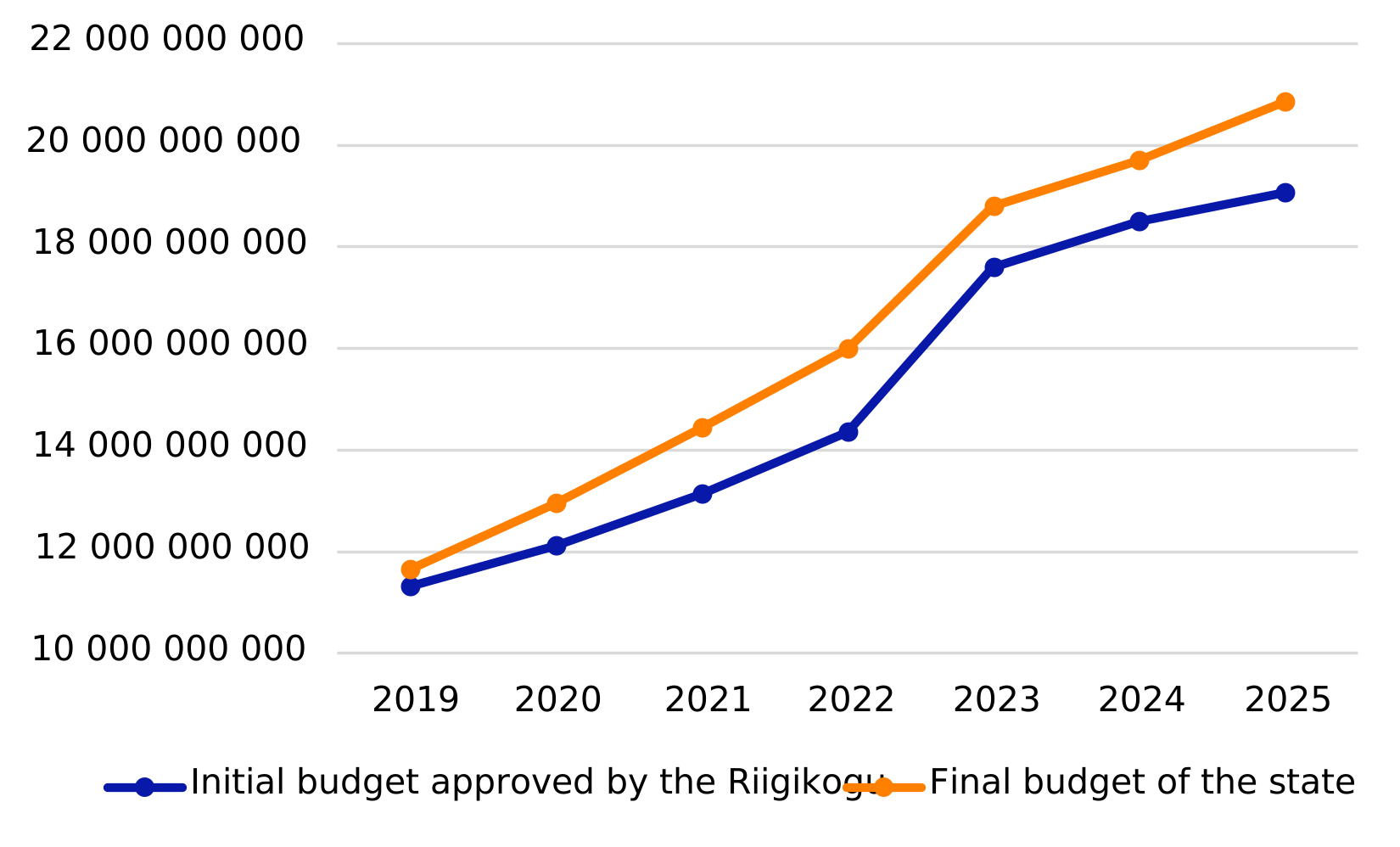
The volume of the annual state budget approved by the Riigikogu and the amount of money actually used in a calendar year, i.e. the final budget, has differed by hundreds of millions of euros in the audited period 2019–2025, and the gap has increased (see Figure 1).
Figure 1. Volume of expenditure and investments in the period 2019–2025 (euros) in the initial annual state budget and the final budget approved by the Riigikogu*
* Expenditure includes depreciation of fixed assets (except for 2019, when the Ministry of Finance did not yet include depreciation in expenditure).
Source: National Audit Office on the basis of data from the Ministry of Finance; as at 06.10.2025
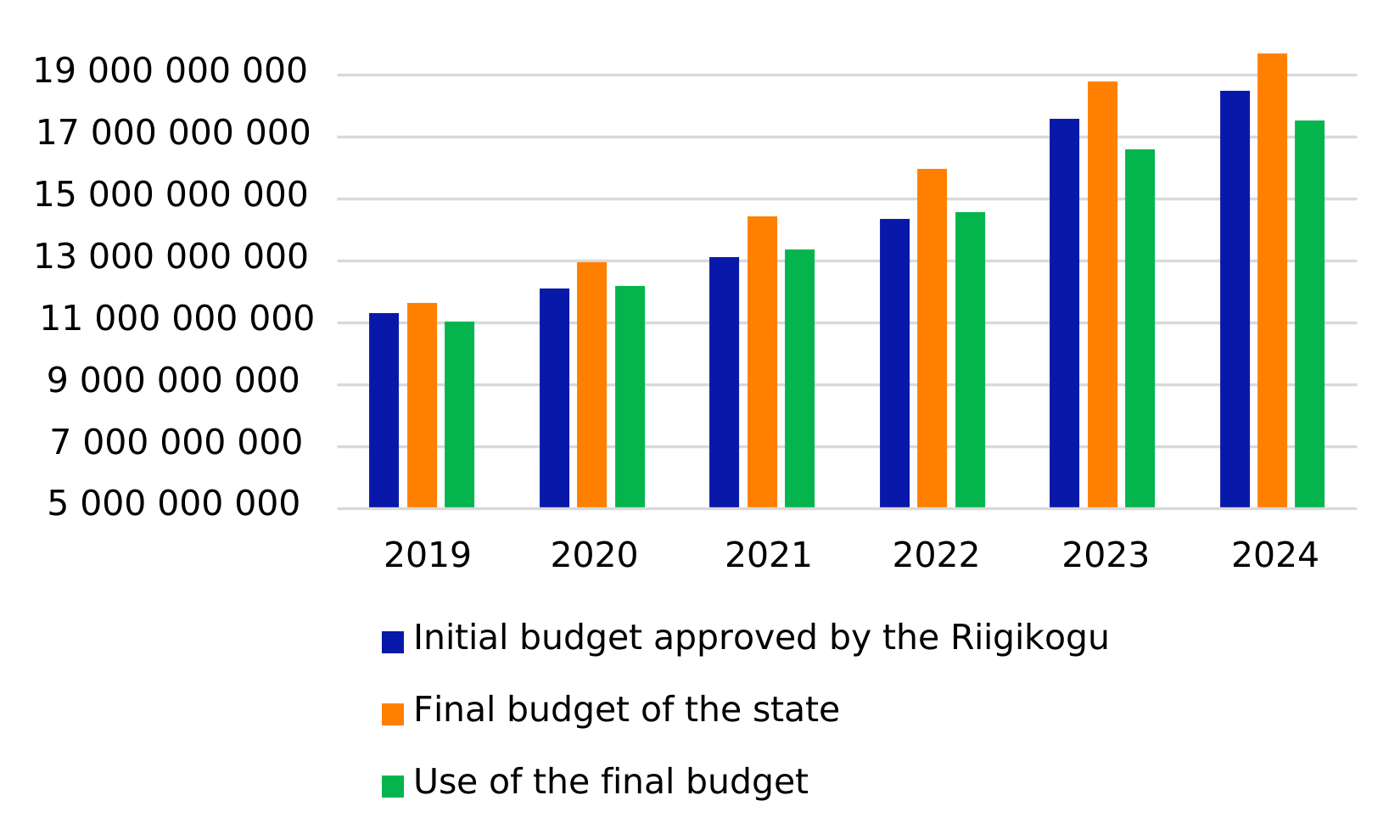
Shifting costs and thus rolling money between years is possible and allowed. In the period 2019–2024, €600 million to €2.2 billion of the state’s final annual budget, or the budget that was available, was not actually spent. €19.7 billion was available for use in 2024, of which €2.15 billion remained unused (see Figure 2).
Figure 2. Volume of expenditure and investment in the annual state budget approved by the Riigikogu, the final available budget and actual use of this budget from 2019–2024 (euros)*
* Expenditure includes depreciation of fixed assets (except for 2019, when the Ministry of Finance did not yet include depreciation in expenditure).
Source: National Audit Office on the basis of data from the Ministry of Finance; as at 06.10.2025
Table 1. Five programme activities and investments with the highest amount of unspent money in the state budget in 2024 (€ million)*
| State budget programme activity | Budget available for 2024 | Unused budget in 2024 |
|---|---|---|
| Climate change mitigation and adaptation (Ministry of Climate) | 355 | 344 |
| Development and maintenance of rail transport infrastructure (Ministry of Climate) | 548 | 288 |
| Military force formation: other units (Ministry of Defence) | 510 | 173 |
| Promotion of the international competitiveness of education (Ministry of Education and Research) | 115 | 74 |
| Benefits and allowances for children and families (Ministry of Social Affairs) | 952 | 60 |
| State budget investment | Budget available for 2024 | Unused budget in 2024 |
|---|---|---|
| Special equipment for defence purposes (Ministry of Defence) | 282 | 43 |
| Acquisition and renovation of buildings and facilities (Ministry of Defence) | 190 | 30 |
| Development of Rail Baltic (Ministry of Climate) | 74 | 22 |
| E67 Päädeva-Konuvere road section (Ministry of Climate) | 13.8 | 13.5 |
| IT investments (Ministry of the Interior) | 19 | 12 |
* The areas of government of the Ministry of Defence and the Ministry of Social Affairs were not audited. Their programme activities and investments are included in Table 1 purely in the sense of a statistical overview of the state as a whole.
Source: National Audit Office on the basis of data from the Ministry of Finance; as at 06.10.2025
Table 2. Top ten state expenditures and investments for which the funds allocated with the state budget cap were not implemented in absolute amounts in the areas of government audited by the National Audit Office in 2024
| State’s activity/investment | Unused funds in 2024 (€ million) |
|---|---|
| Transition to Estonian-language education (Ministry of Education and Research) | 43.2 |
| Support for research and development, innovation and entrepreneurship (Ministry of Economic Affairs and Communications) | 41 |
| Strengthening the foundation of digital state (Ministry of Economic Affairs and Communications) | 13 |
| One-off grant to local authorities and private general education schools for the purchase of computers (Ministry of Education and Research) | 11 |
| Expenditure and investment in the state’s fleet (Ministry of Climate) | 9.3 |
| Regional, agricultural and fisheries support (Ministry of Regional Affairs and Agriculture) | 9.2 |
| Increasing the climate resilience of electricity transmission networks (Ministry of Climate) | 8.6 |
| Environmental programme of the Environmental Investment Centre (Ministry of Climate) | 8.5 |
| Finishing the construction of the eastern border (Ministry of the Interior) | 6.7 |
| Support for physical education and science subjects in schools (Ministry of Education and Research) | 5.4 |
* Please note! The table only includes the money with the state budget cap that remained unused in 2024 and does not include expenditure and investment from external subsidies or revenue from sales of CO2 quota. Due to the lack of a comparable methodology and information, it is difficult to say what the budget allocated to the activity/investment was like.
Source: The National Audit Office on the basis of the following documents – materials submitted by ministries to the Finance Committee of the Riigikogu and explanatory memoranda accompanying the directive of ministries extending the use of unused funds in 2024 by one year; as at 06.10.2025
The National Audit Office assessed the following during the audit: why a significant proportion of the state budget expenditure and investments are not made by the areas of government at the planned time; whether it is known how this affects the objectives and results of the area of government; the reasons ministers give for extending the time for use of the money; and how experience and information on the use of money is taken into account in subsequent spending requests and decisions. The audit was prepared on the basis of the data and explanations from and examples of the following ministries: Ministry of Climate, Ministry of Economic Affairs and Communications, Ministry of Education and Research, Ministry of the Interior, Ministry of Regional Affairs and Agriculture, Ministry of Finance.