
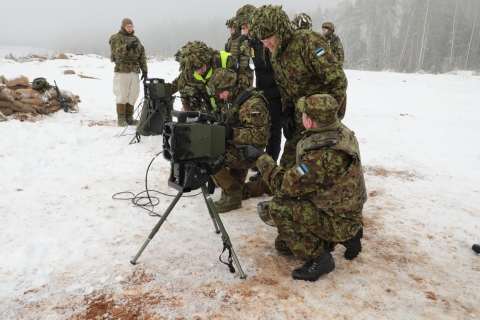
The Estonian Centre for Defence Investment (ECDI) has improved its procurement practices in all respects in the period 2020–2023, from pre-procurement activities to monitoring contract performance. The roles of the Estonian Centre for Defence Investment and the Defence Forces in organising procurements are more clearly divided both in documentation and in practice. There is still room for improvement primarily in documenting market research and in complying with the terms of framework agreements. The procured equipment corresponds to the needs of the Defence Forces and is reflected in development plans.
In 2022, the Ministry of Defence submitted to the Government of the Republic a plan to improve defence capability in the total amount of EUR 816.3 million. In the opinion of the National Audit Office, the additional funds have been used in accordance with what was agreed, and the new procurements carried out with these funds have generally been organised transparently.
What did the National Audit Office audit?
In 2020, the National Audit Office published a report entitled “Planning and Cost-Effectiveness of Large-Scale Defence Procurements”, which identified several shortcomings and made a number of recommendations to the Ministry of Defence, the Defence Forces and the Estonian Centre for Defence Investment.
In the current follow-up audit, the National Audit Office selected large-scale defence procurements that were organised after the new procurement rules of the Ministry of Defence’s area of governance entered into force on 30 April 2020. The National Audit Office assessed whether the shortcomings identified in 2020 in procurement planning, conducting market research, preparing technical specifications and, depending on the progress of the procurement, also in contract performance and quality control, have been remedied.
In addition to procurements carried out in 2020–2023, the National Audit Office reviewed two earlier procurements (the procurement of automatic firearms and long-range anti-tank systems), as the equipment resulting from these procurements had not yet been delivered at the time of the 2020 audit. The National Audit Office assessed whether the contracts had been properly performed and whether the equipment agreed upon had been received.
Russia’s actions, including the full-scale war against Ukraine that began on 24 February 2022, prompted the Ministry of Defence to prepare and submit to the Government of the Republic a plan to improve defence capability (EUR 339.5 million in January and EUR 476.8 million in March) . The additional funding was largely planned for the procurement of defence equipment and infrastructure. The National Audit Office reviewed how the additional funds were used and checked whether procurements related to the additional funding were organised transparently.
Key observations
Use of additional funding
The audit found that the additional funding planned in 2022 to improve defence capability was used in accordance with what was agreed, i.e. the use of the additional funds focused on increasing ammunition stocks and firepower. Procurements organised using the additional funding were generally carried out transparently. Equipment was procured using framework agreements concluded as a result of earlier procurements, but new procurements were also conducted.
The audit revealed that in three cases the maximum value of previously concluded framework agreements was exceeded. In the case of new procurements, the National Audit Office identified shortcomings in the documentation of market research. In procuring equipment with the additional funds, the National Audit Office also identified some delays in deliveries.
Organisation of procurements carried out in 2020–2023
The audit showed that the need for the procurements included in the sample and carried out in 2020–2023 generally stemmed from the strategic development documents in force at the time—the military defence section of the National Defence Development Plan and the Ministry of Defence Development Plan—or were related to the initial lessons learned from Russia’s full-scale war against Ukraine.
However, in one procurement (the procurement of sniper rifles), the National Audit Office found that the volume planned by the Estonian Centre for Defence Investment cannot be linked in any way to the actual needs of the Defence Forces (based on the Defence Forces’ tables of organisation and equipment) and allows the procurement object (sniper rifles with additional equipment) to be purchased in quantities many times greater. Most of the volume of the concluded framework agreement is not intended for the procurement of sniper rifle sets, but rather for the procurement of additional equipment for other sniper and precision rifles in use by the Defence Forces.
By acting in this way, the Estonian Centre for Defence Investment has not clearly, precisely and unambiguously disclosed what is being procured and in what quantities. Consequently, competition has not been ensured in the best possible way when procuring additional equipment.
Compared to the 2020 audit, pre-procurement activities have improved, but problems with market research persist. The National Audit Office did not identify problems in the preparation of technical specifications or in the justification for choosing procurement procedures that restrict competition. However, there are still situations where information collected in the course of market research is not documented or is not retained to a sufficient extent. Of the 15 procurements included in the audit sample, two lacked the necessary and documented market research, and in three cases there were grounds for criticism regarding the quality of documentation. Market research documents sometimes lack information on when and on what sources the document was prepared, and in some cases the conclusions drawn from the research were also missing.
Conducting up-to-date market research and documenting it properly is important to ensure that all persons involved in organising the procurement are aware of the preparatory work and that continuity of existing information is ensured when personnel involved in the procurement change. Proper documentation also helps to increase transparency regarding which alternatives were considered in preparing the procurement.
The audit showed that the contracts related to the procurements included in the sample were generally performed in accordance with what was agreed, including compliance with contract prices, delivery deadlines and the completeness of the delivered equipment. An information system exists for monitoring contract performance, but errors have been made in entering data into the system, which may in turn affect the quality of decisions made on the basis of the information obtained from it. As the information system MS DAX , used across the Ministry of Defence’s area of governance, is one of the data sources for material combat readiness, it is important that the data it contains are correct and complete.
Follow-up on procurements audited in 2020
The audit showed that problems occurred with deliveries in the performance of contracts concluded under the procurement of automatic firearms. Most deliveries were delayed, and the Estonian Centre for Defence Investment did not respond to the breach of contract terms (delivery delays) in a manner that would have been possible under the contract, nor did it impose contractual penalties for the breach. The main reason was that the procurement volume was large and the procured equipment consisted of many components, and the Estonian Centre for Defence Investment was unable to monitor contract performance and deliveries sufficiently promptly and respond accordingly. The delivery delays did not have a direct impact on the combat readiness of the Defence Forces, as the Defence Forces were able to continue using older automatic firearms until the arrival of the new weapons.
In the procurement of long-range anti-tank systems, the Estonian Centre for Defence Investment significantly amended the terms of the framework agreement. The audit revealed that the Centre increased the volume of the framework agreement fivefold. In addition, the Estonian Centre for Defence Investment procured disposable anti-tank weapons under the framework agreement that do not comply with the procurement documents or the terms of the framework agreement. Such a significant change to the value and other terms of a framework agreement is contrary to the Public Procurement Act.
Recommendations of the National Audit Office
Recommendations of the National Audit Office to the Director General of the Estonian Centre for Defence Investment:
- In the future, define the subject of the procurement based on what is actually planned to be procured and in what financial volume.
The subject and volume of the procurement are determined based on what is actually planned to be procured and in what quantities, taking into account strategic documents and the needs of the Defence Forces. In determining the volume of the sniper rifle procurement, potential future life-cycle costs have also been taken into consideration.
- Establish minimum requirements in the procurement rules of the Estonian Centre for Defence Investment for the documentation prepared as a result of market research and ensure that market research results are retained in a reproducible form.
The Estonian Centre for Defence Investment is currently updating its procurement rules, as part of which the area of market research is also being reviewed. The procurement rules are planned to be updated by the end of 2024.
- Improve work processes so that the Estonian Centre for Defence Investment, which supervises contract performance, identifies and corrects errors made when entering data into the MS DAX information system.
Updates have been made to the MS DAX information system that improve data quality and enhance oversight.
- Do not make material changes to the terms of framework agreements and, in the future, procure only equipment that complies with them.
The Estonian Centre for Defence Investment complies with the requirements arising from the Public Procurement Act when concluding and performing contracts. Only equipment that is consistent with the procurement base documents and the framework agreement is purchased under framework agreements.
The procurement of long-range anti-tank systems was carried out at a time when the criteria related to determining and amending the procurement value were not interpreted in a manner that, in the case of procurements exceeding the international threshold, would have required setting a maximum procurement value or prohibited subsequent adjustments. Initially, the Public Procurement Register reflected the value of the first procurement contract rather than the total value of the framework agreement. In 2022, the volume was amended to correspond to the actually planned volume.
According to the Estonian Centre for Defence Investment, the framework agreement concluded under the procurement of long-range anti-tank systems allows the procurement of disposable anti-tank weapons, as the procurement object is generally described in the contract as missiles rather than a specific product. In addition, at the time of the procurement, market conditions were such that organising a new procurement would have resulted in the same cooperation partner. Therefore, organising a new procurement would have created an unjustified time and administrative burden for both parties.
No evidence was presented to the National Audit Office during the audit to show that the intention from the outset was to procure long-range anti-tank systems worth EUR 200 million. Public communication has also referred to EUR 40 million as the value of the framework agreement. For most of the volume of the framework agreement, disposable anti-tank weapons were procured instead, which were not originally intended to be procured. The technical specifications required a firing range of at least 4,000 metres, which the procured disposable anti-tank weapons do not meet.
The documents submitted regarding the market research on medium-range anti-tank weapons do not demonstrate how thorough the market research was or what conclusions were drawn. The Estonian Centre for Defence Investment has not convincingly justified why the procured anti-tank weapons were the only possible option.
The audit revealed that most of the volume of the framework agreement was planned for the procurement of additional equipment for other sniper and precision rifles in use by the Defence Forces. Consequently, the actual subject of the procurement differs from what was described in the procurement documents. It was not possible to submit bids for the additional equipment separately. In the opinion of the National Audit Office, competition is not ensured in the best possible way when procuring additional equipment for other sniper and precision rifles in use by the Defence Forces in this manner.